
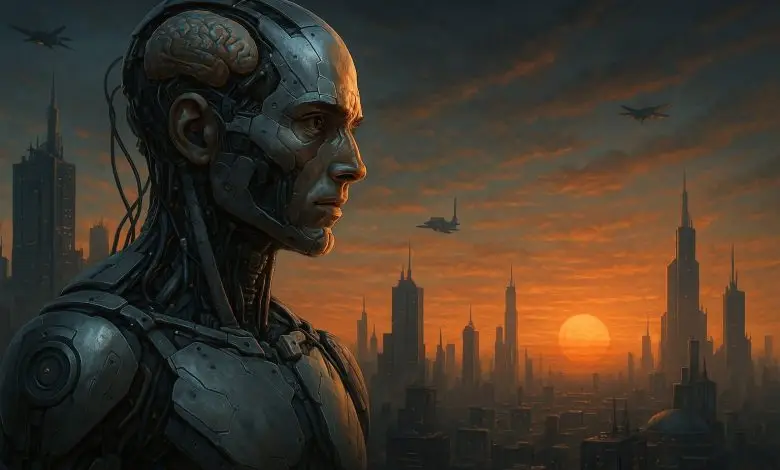
For thousands of years, the story of humanity has been a sweeping saga, an ascent from cave-dwelling, animal-like beings to a civilization powered by satellites, algorithms, and machines of extraordinary intelligence. No other species, at least in the observable universe, appears to have traveled such an astonishing evolutionary arc. Early humans battled harsh climates, discovered fire, hunted for survival, and slowly shaped language. Each breakthrough nudged our species toward a future no one could have imagined.
Then the great turning points arrived: the Agricultural Revolution pulled humans into settlements, property ownership, and complex societies. The Industrial Revolution reconfigured life through machines, factories, and the tyrannical discipline of the clock. And now, in this Digital Revolution, humans wield the power of instantaneous information, global communication, and thought-level computation. Our gaze is no longer fixed on Earth alone, we actively contemplate other planets as destinations.
Yet, at the very moment we explore the cosmos, we also stand at a strange intersection where humanity itself is transforming. Our identity is gradually shifting from purely biological beings to hybrids, part human, part machine. Science calls this emerging entity the cyborg.
What Exactly Is a Cyborg?
Simply put, a cyborg is a being whose body integrates both human organs and mechanical or electronic parts that enhance physical or cognitive abilities. An artificial heart valve, a cochlear hearing implant, a brain-embedded chip, or robotic limbs that outperform natural ones, these are early expressions of cyborg identity.
The idea is not limited to medical necessity anymore. Today’s technologies aim to amplify human capability far beyond natural limits.
Google Glass, Neuralink, brain-controlled prosthetics, exoskeleton suits, these innovations carry a simple message: the human being of tomorrow will not be bound by the human limitations of today.
The term “cyborg” was coined in 1960 by scientists Manfred Clynes and Nathan Kline, who described it as “a creature composed of biological and mechanical systems.” We already see this hybridization around us, pacemakers, artificial limbs, automated kidney and lung machines, many powered by batteries or even body heat.
Human enhancement is no longer science fiction; it is quietly becoming routine.
The Digital Invasion of Everyday Life
Think for a moment about how deeply technology has penetrated our daily existence.
Your day begins with a digital alarm.
Your health is monitored by a smartwatch.
Your questions are answered by Google or ChatGPT.
Your education, banking, medical consultations, even your social identity, flow through screens and servers.
Hospitals use precision tools like CyberKnife, and in the United States, artificial intelligence has already outperformed several top medical specialists in clinical diagnosis. Biotechnology now produces vaccines and micro-devices that can store complete data about your identity, mobility, and health.
Technology is no longer around us. It is inside us.
And that transformation raises a profound question:
Are we on the path to becoming machines ourselves?
Evolution at Warp Speed
Anthropologists estimate that it took nearly six million years for early humans to evolve into anatomically modern humans. Nature worked slowly, shaping our limbs, shrinking our intestines, changing our sensory structures.
But today, evolution has accelerated beyond imagination.
We are no longer passively shaped by nature; we are actively redesigning ourselves. We replace organs, integrate chips, sense information through electronic signals, and link our cognition to artificial intelligence.
This is no longer natural evolution.
This is artificial evolution, designed, engineered, and rapidly advancing.
If this continues, the question becomes unavoidable:
What will the human of the future be?
When Thoughts Upload, Emotions Download
Imagine a world where:
Data can be uploaded or downloaded directly into the brain
Emotions can be modified through computer code
Memories can be edited like files
Death loses its finality because machines can assume control of failing biological systems
In such a world, what remains of the concept of humanity?
What becomes of morality, society, identity, or consciousness itself?
The transformation is not just biological. It is ethical, social, psychological, and philosophical.
A New Class System: The Augmented vs. The Natural
A new form of inequality may emerge:
Those who can afford technological enhancements, superior vision, greater strength, higher intelligence, will form a new elite. Those without enhancements may remain limited by natural human boundaries.
This divide will reshape power, employment, social mobility, and even cultural influence.
Old class systems, racial biases, or fascist hierarchies may pale in comparison to this new techno-class divide.
As my friend, the critical thinker Jami Chandio, raises the uncomfortable question:
“Are we choosing this future? Or are we being pushed toward it by global markets and the powerful owners of technology?”
When Machines Access Our Thoughts
Artificial intelligence and cyborg culture may eventually create new systems of governance, subtle, pervasive, and nearly invisible.
If powerful institutions can access our thoughts, predict our desires, and shape our behavior, then how will freedom of thought survive?
Imagine a future like The Matrix, where internal experiences are controlled externally.
If emotions, ideas, and identity become programmable code,
what happens to the soul of humanity?
The Promise, and Price, of Immortality
Becoming cyborgs may unlock extraordinary possibilities.
Humans may:
Reverse aging
Achieve semi-immortality
Expand cognitive capacity infinitely
Gain access to unimaginable knowledge
But at what cost?
Will empathy, imagination, and natural beauty disappear?
Will a machine-augmented being shed tears at a soulful melody?
Will it feel the ache and ecstasy in the poetry of Ghalib or Bhittai?
Will a sunset still inspire poetry or music?
If not, then what exactly will survive of the human spirit?
The Point of No Return
We are standing at a historic crossroads.
The question is no longer:
“Will we become cyborgs?”
The real question is:
How much of a cyborg will we become? And when the transformation is complete, will we still be human?